Workstation
Work where the repository already lives
A launched local agent gets a real git worktree, the repository setup and explicitly allowed build caches. Source stays on that workstation unless you choose a workflow that uploads it.
Agent platform
Start beside your local toolchain, move an interactive session to cloud capacity, or let CI wake a tightly scoped Factory agent. Hive keeps the session, branch, PR, CI and spend in one workspace.
The lanes share a control plane—not one undifferentiated security model.
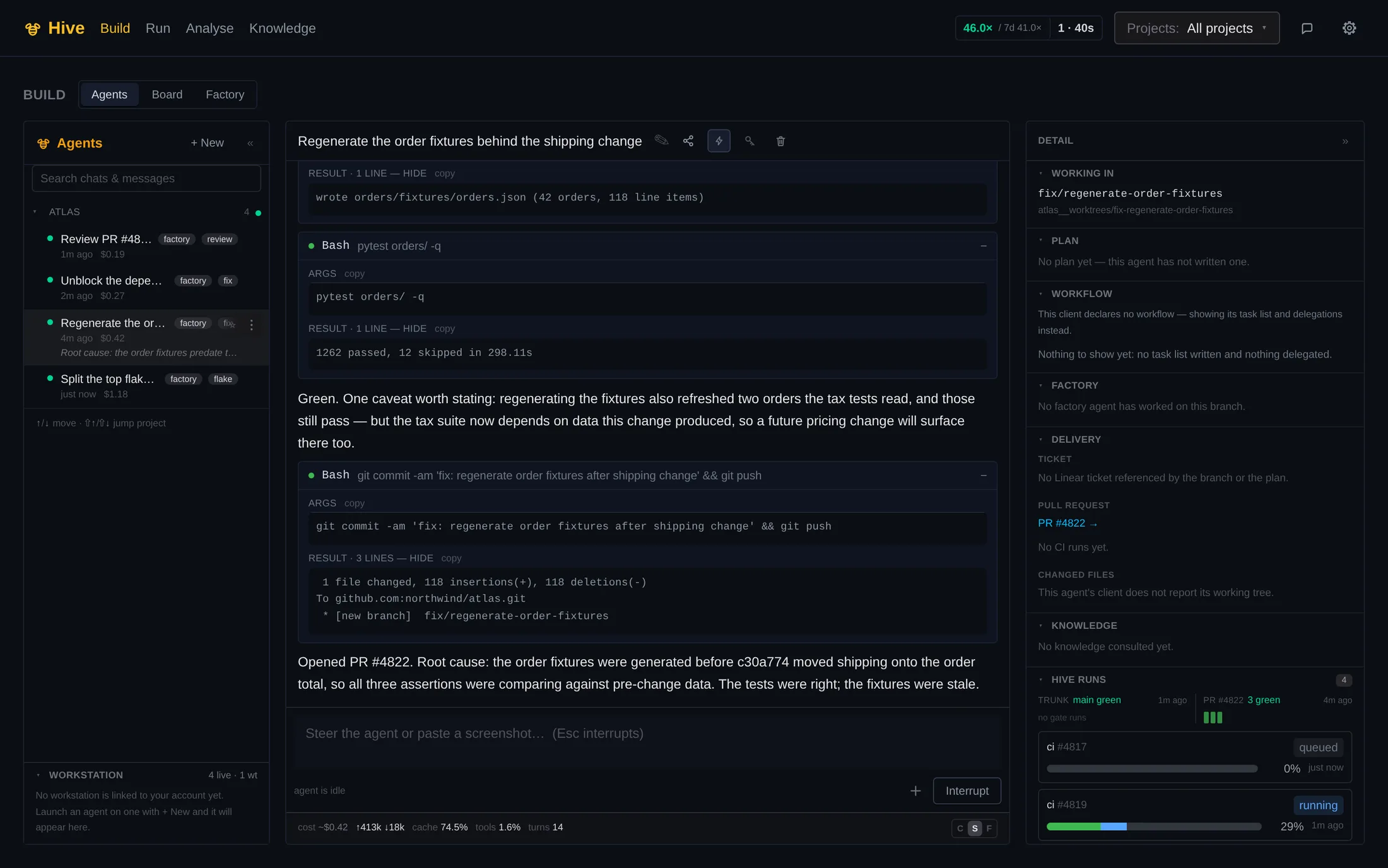
A Factory session inside the agents workspace: the transcript with its tool calls, the plan beside it, and the pull request it opened.
Captured from the committed fixture set, not from production
Three execution lanes
Hive does not pretend a laptop shell and a CI container are the same thing. It gives each lane the controls and containment its job requires.
Workstation
A launched local agent gets a real git worktree, the repository setup and explicitly allowed build caches. Source stays on that workstation unless you choose a workflow that uploads it.
Cloud
An interactive Pi session runs in an ephemeral, resource-capped pod. Steer it from the browser, then let the delivery wrapper preserve its commits and PR.
Factory
A pinned Pi runtime runs as an ordinary Hive workload. Compiled context, reviewed capabilities, budgets and git policy stay outside the model.
Workspace
Live transcript, plan, workflow, files, branch, PR, CI and approvals sit beside each session instead of across terminal tabs.
Teams
Group sessions into a team, see branches and claims together, pass durable notes, and surface overlapping work before delivery.
Ownership
Conversations are owner-only by default. Viewer shares are read-only; drive access is reserved for cloud sessions, where the owner’s machine is not exposed.
Start one, steer it, read it back
A session is not a tab you have to keep open. It is addressable.
hive launch starts a session on the machine you name and attaches you to it. From then on the session reports its phase, plan, worktree, branch and pull request into the workspace, whether or not anyone is watching.
steer_agent queues a message the session claims on its next turn; read_inbox is how a session hears from its team. Both are MCP calls, so the agent you already use can drive them without opening Hive at all.
$ hive launch --repo acme/shop --branch fix/checkout-total --target workstationsession as-7f3c · workstation · worktree ready steer_agent { "session_id": "as-7f3c", "text": "Keep the fix inside orders/." }→ queued · claimed by the session on its next turn read_inbox { "session_id": "as-7f3c" }→ 1 team_message: "PR #4822 is green — add a changelog line before merge."Native integration
Hive already knows the run, tests, branch and delivery state. Agents receive narrow calls to that system instead of credentials to scrape it.
Observe
Follow turns, tool calls, costs, plans, workflows and attention state without attaching to the machine that hosts the agent.
Act
Owner controls ride a durable command channel. A queued command remains visible until the client claims and reports it.
Verify
Working-tree state, pull request and Hive checks share the rail, so “done” is measured against delivery rather than the last assistant message.
Access model
The UI explains which controls are possible instead of rendering every session as equally steerable.
| Role | Controls | Available on |
|---|---|---|
| Owner | Read · steer · interrupt · approve · end | Every own session |
| Viewer | Read transcript and live stream | Named read-only share |
| Driver | Steer · interrupt · switch model | Cloud sessions only |
| Factory observer | Run, transcript, result and spend | No workstation control |
Who this is for
Under the surface
Private beta
Start on your own runner, keep your existing CI beside it, and watch Hive turn the next eligible red check into a reviewable fix.